Hello everybody,
here I am with the post everybody was waiting for. It took me some time to get into it but finally here it is.
So last month I made one of the biggest trips in my life if not the biggest and went to Iceland together with my friend Albert. Iceland was always one of my dream destinations and my urge to go there became bigger after seeing The Secret Life of Walter Mitty a couple of years ago (watch it if you haven’t seen it yet). I must say that the movie or pictures of Iceland on instagram that I was checking out before the trip don’t lie. It is a beautiful island with breathtaking sceneries at every corner which you won’t find anywhere else and pictures can’t hardly capture all the mesmerizing beauty and power of the Mother Nature. Or if you believe in God, he was super generous with waterfalls while creating Iceland. I have never seen so many waterfalls in my whole life and I’m not talking only about the big and famous ones like Goddafoss, Skogafoss or Gullfoss, smaller and very small waterfalls, that don’t even have a name, come from every piece of mountain in Iceland. Simply they’re everywhere!
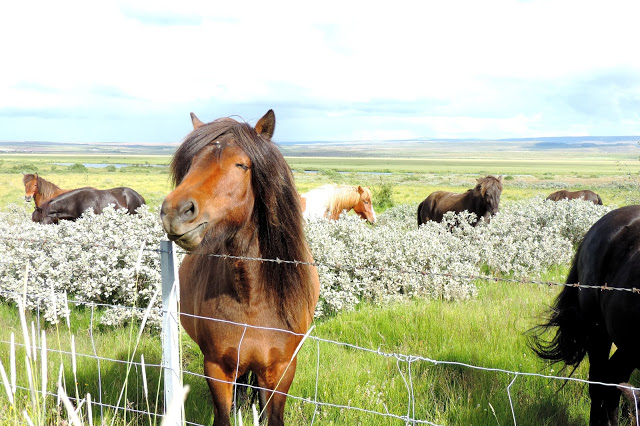


Driving through Iceland, despite the long distances and sometimes very thrilling roads, was an amazing experience and we had to stop several times just to take some photos. The abbundance of sheep, the idyllic farms, the hobbit-like turf houses, the Icelandic horses, the lava formations and ice glaciers, the 24-hour daylight in summer, the geothermal energy and its creative use..Add it all up it becomes apparent why there really is no place in the world like Iceland.
But to give you more details which you asked for, let me tell you how the trip went. July and August are the best months to go to Iceland if you wanna drive around the whole island or if you don’t plan to rent a car because later on the tourist buses don’t operate anymore. In July you can experience the 24-hour daylight but later on in the middle of August, when we were there, the sun sets around 9.30 pm and rises after 4 am. If you go in the second half of August like us you may see the first aurora borealis. We weren’t so lucky as the sky was mostly cloudy but we saw a bit of it from the plane on the way back. That brings me to the flight connection we made. We took an Emirates flight from Dubai to Frankfurt and then Icelandair to Keflavík airport in Iceland. Icelandair operates from many cities in Europe and North America so you just need to check which one is the best for you. We chose Frankfurt because all the other Emirates flights to Northern Europe were full or the timing wasn’t good. On the way back we flew via Paris. Other airlines that fly to Keflavik is SAS or WOW.
Keflavík is close to Grindavík where the famous Blue Lagoon is and it’s aprox. 50 minutes from the Iceland’s capital Reykjavík. We rented a car which was waiting for us at the airport. We rented a normal Hyundai and it survived a lot with us. The so called Ring Road which goes around the whole island is mostly in good conditions however there are some pieces of gravel road especially in the south east which weren’t very pleasant in a small and rented car. Make sure your insurance includes damage from gravel. Some of the roads are also impassable during the winter. If you want to explore Iceland’s highlands or drive to the glaciers you will need a 4×4 car. Some roads are really nerve-wracking so if you have some extra money to spend, go for a bigger car. We also met people driving through Iceland on a motorcycle or people who were hitchhiking and taking the tour buses. But as I said the buses operate only in summer and you need at least 20 days to move around with them if you want to see the whole Iceland. The most beautiful part as many people say are the Westfjords and you have to take a ferry to go there. Unfortunately we didn’t have enought time to go there but we still drove around the whole Ring Road.
We started our journey visiting the National Park of Pingvellir, the biggest waterfall in Iceland Gullfoss and the famous Geysir in Haukadalur. These three sights form the Golden circle, a popular day tour for tourists in Iceland. Normally people head to Vík to spend the night there but I must say it’s a really long drive and we prefered to stay in Hella which is near the famous volcano Eyjafjallajökull which erupted in 2010. I cannot but reccomend the Lax-á-Ranga wooden cottages for an authentic and romantic experience of Iceland. It was our favourite accomodation throughout the journey. Talking about the accomodation in Iceland, the best solution are guesthouses or airbnb. They are mostly very nice and have a kitchen and a shared or a private bathroom. Prepare yourself that you will pay a little more than in Europe for everything in Iceland. It’s and expensive country. One good thing is that you can pay everywhere with your card, we didn’t even see what the local money looks like as we didn’t need them. Also if you plan your trip to Iceland in summer, book your accomodation at least two or three weeks ahead, it might save you some money. We waited too much and then we didn’t have many possibilites to choose from. So be wiser and especially in summer, plan your trip well.
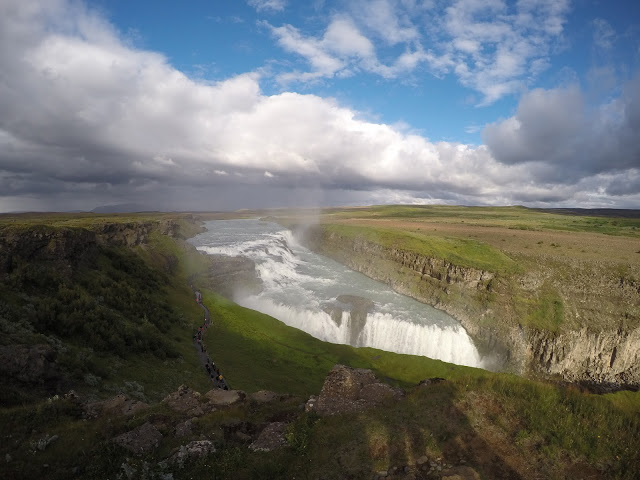 Gullfoss
 Skogafoss
The second day of our journey was no doubt the busiest and the most tiring one as we managed to see the waterfalls Seljalandsfoss and Skogafoss, Eyjafjallajökull volcano, the deepest Icelandic canyon Fjaðrárgljúfur and the glaciers in the south of Vatnajökull national park with Jökulsárlón ice lagoon which was definitely the highlight of the day.

 Jökulsárlón ice lagoon
Well, we also hit some low points during the day and the whole journey and mostly because of the weather. They have a saying in Iceland which says: “If you don’t like the weather in Iceland wait 5 minutes!”and it was mostly like that, sunny moments were followed by heavy rainsand fog and vice versa. But sometimes the heavy rain and thick fog wouldn’t go away for hours and it ruined our days because we couldn’t see anything. That’s why we didn’t go to Vik and its famous beach or couldn’t see much in Seydisfjordur or Snaefellsnes Peninsula. The weather was against us. Luckily when we reached the north of Iceland the weather was perfect so we could enjoy the natural geothermal baths in Mývatn which are not as fancy as the Blue Lagoon but it’s still pretty nice and for half of the price.

And back to the waterfalls, this time in the north and this one is one of the most spectacular one and it’s also had a key role in the Icelandic history. The story says that in the year 1000 the Lawspeaker Þorgeir Ljósvetningagoði made Christianity the official religion of Iceland after spending a night at this waterfall called Goddafoss – waterfall of gods. Well, that’s the romantic story. Perhaps under the pressure of Christianity’s “convert or die methods”, Þorgeirr chucked his icons of Norse deities into the falls (but secretly maintained
allegiance to the Norse deities). No matter how exactly the story was it doesn’t change anything about the fact that this curling horseshoe waterfall with blue waters is dazzling and it became my favourite.
 Goddafoss
 Crater Viti
Iceland doesn’t have many big cities, in fact there the capital has about 180 000 inhabitants and other two big cities in the capital region have about 30 000. Akureyri in the north with only 18 000 inhabitants is the largest city outside of the capital region. It may be small but it has such a charming and unique ambience that you have to immediately fall in love with it. It’s full of art galleries, cool bars and restaurants and it’s so beautifully setted in the longest of icelandic fjords surrounded by the mountains.
One of the most famous towns in Iceland is Húsavík with just 2200 inhabitants. Why is it so famous? For its whale watching. In fact you can spot up to 11 different types of whales including the big Blue whale. We couldn’t go..the sea was too agitated and it wouldn’t be very pleasant. A part from that it’s a really cute little town with colourful houses and the harbour is stunning. Trust me, after driving through some villages formed just by three houses (apparently 10 inhabitants form a municipality in Iceland) a town with more than 1000 inhabitants seems huge to you. 🙂
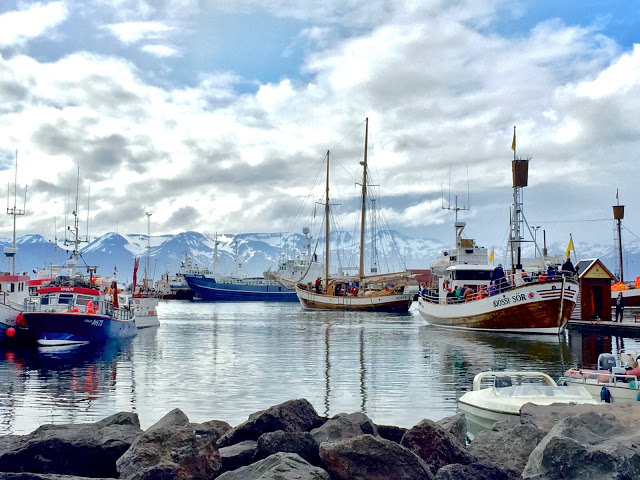 Húsavík
 Beautiful double rainbow on the way to Akureyri
 Beautiful sunset on the way to Akureyri
Akureyri’s fjords
 Akureyri city center
Descending back to Reykjavík we stopped in Snaefellsnes Peninsula which is the one that Ben Stiller visits in the movie. They call it “Iceland in miniature” because the peninsula is home to many of the beautiful landscapes found elsewherein the country. If you don’t have time to drive around the entireisland, a visit to the Snaefellsnes Peninsula will give you an idea of what you would have seen if you had – moss-covered lava rocks, craggy seaside cliffs, strange rock formations made by the sea, a giant glacier, majestic fjords, windswept beaches, tiny fishing villages and even some rolling farmlands dotted with sheet and horses to boot. Fortunately we had time to drive around the whole island because we didn’t see much of the beauty in Snaefellsnes. The weather was horrible and very unpleasant, the giant glacier of Snaefellsnesjökul, which you can normally see from far, was hidden behind a thick fog. At least we visited a lovely town Stykkisholmur featured in already mentioned Ben Stiller’s movie (that’s the place he finishes his longboard drive) and one of the most photographed sights in Iceland Mount Kirkjufell. Kirkjufell in icelandic means church mountain and it’s dazzling. No wonder it attracts so many photographers. Especially during the summer when the sun doesn’t completely set and you can enjoy hours of colourful sunset in the background.
 Mount Kirkjüfell
Last two days of our journey were spent in the Icelandic capital – Reykjavík. This quirky city has a very unique atmosphere and people here are fashionable, young and proud to be one of the sexually most open cultures in the world. The Gay and Lesbian Organisation was founded here already in 1978 and today lesbians and gays in Iceland stand equal to heterosexual people in the eyes of the law and prejudice is on the retreat. There are many gay bars in Reykjavík and I think I had never seen so many rainbow flags before. In fact they have one full rainbow street in Reykjavík right in the city center.
And with a coffee in a hipster bookshop in the city center our journey had come to an end. It was ten days of adventure, infinite exploring and so much beauty concentrated in one place that our eyes couldn’t believe it sometimes.
My only advice at the end of this post is: GO! Iceland is worth it and you will never find anything like that!
And don’t forget to be happy, bee on cloud 9! 🙂
Love
Beata
 Reykjavík’s rainbow
 View over Reykjavík from the church Hallgrimskirkja
This is a map of strategic points in our journey also the points we stayed in. You might want to cut the way from Hella to Djupivogur in half or if you find accomodation in Vik, stay there instead of the area of Golden Circle. We didn’t have other choice but the drive on the second day from Hella to Djúpivogur was too long.


